/
Sky Elements

"The Shade team loves file storage as much as we love drone shows. You can talk to them, make a suggestion, and they take it to heart because they want to make the best product out there."
Brian Geck
Creative Director & Co-Founder @ Sky Elements
WEBSITE
HEADQUARTERS
Dallas-Fort Worth, TX
STRUCTURE
Remote, Global, 24/7
INDUSTRY
Live Entertainment
SWITCHED FROM
SharePoint, OneDrive, Frame.io, standalone DAM
1
About Sky Elements
The company behind the Deadpool & Wolverine, Super Mario, and Toy Story 5 Drone Shows
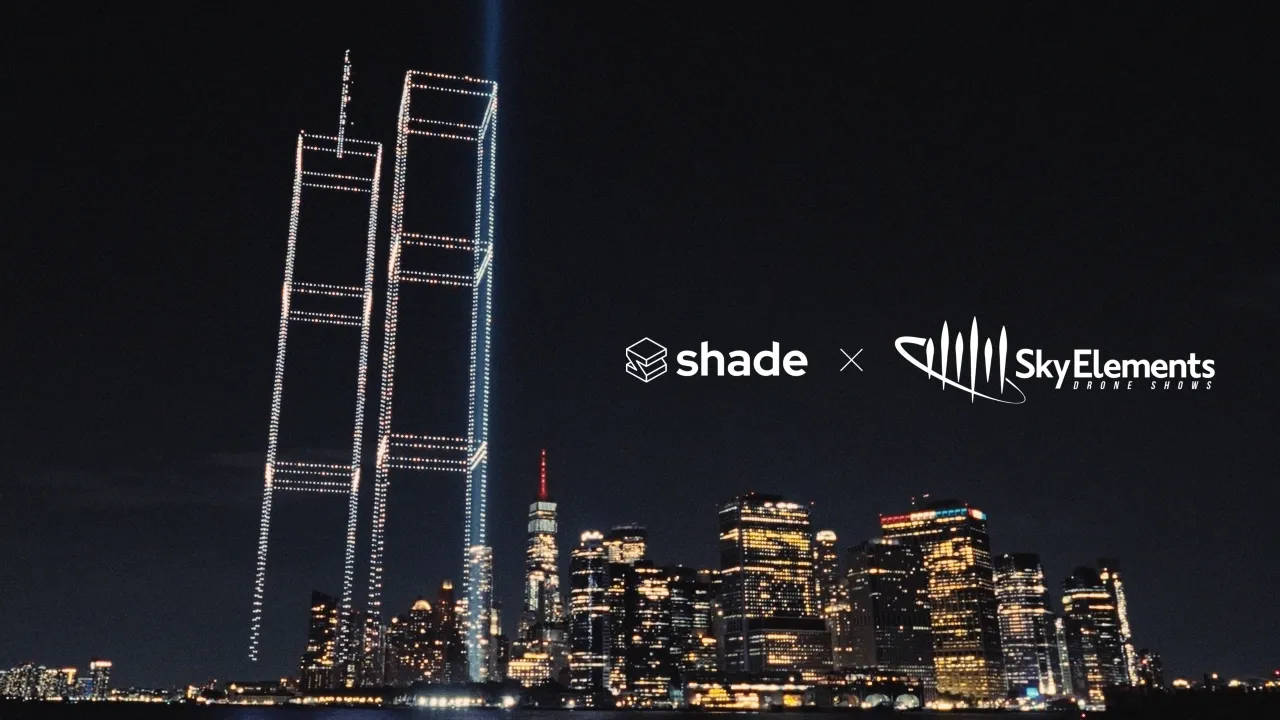
Sky Elements produces drone light shows across the United States. Picture a large fleet of drones at night, each carrying lights, all synchronized to music and drawing shapes in the sky. Their shows have been part of major events from MLB Baseball games to major film promotions over the last few years. They were the first company in the United States allowed to attach pyrotechnics to drones and they flew the Deadpool & Wolverine premiere at San Diego Comic-Con which was one of the first and largest pyro drone shows. They’ve also flown the Super Mario Bros. Movie release and a full tour of shows for Toy Story 5, and they fly regularly for around eight Major League Baseball teams and a number of minor league clubs.
They now fly so many shows that the team has lost count. “It’s always fun when you hear from family and friends, hey, I saw a drone show, was that you guys? And you’re like, I think so,” said Harrison Ward, who runs IT and also pilots shows for the company. “You don’t know them all anymore, but you can look at a show and go, that’s Sky Elements.”
The people behind those shows are spread out. The animation team works from home across the country and around the world. The content team films lots of shows and runs social media. Pilots and field crews work from Starlink connections, hotel rooms, and conference centers, and the company runs 24/7 with people on almost every continent.
2
The Challenge
Breaking limits in an old file system
Before Shade, Sky Elements ran on SharePoint and OneDrive. The volume of files they produced pushed well past what those tools were built for. “Not 10x. We were at 100x the limits and paying massive overage fees a month,” Harrison said.
The bigger problem was the file count. Their show pipeline used to generate a separate path file for every drone in a show, which added up to hundreds of thousands of small files. Those files kept breaking sync. If someone got a new computer, or their OneDrive sync broke, it took three days to sync back down. When an animator rendered a show, the update pushed out to the whole organization and, in Harrison’s words, would “just brick everybody.” Before Shade, OneDrive sync failures were the number one IT request he received.
Large files caused a different kind of pain. “If you have 20 people having to download something on a throttled connection that is multiple gigabytes, and then work with it and then upload it again, and then also upload the end result to this other service, it just really creates a lot of friction,” said Brian Geck, Creative Director and co-founder. On top of storage, the content team was paying for its own DAM, and client reviews were running through Frame.io.
Learn why top agencies, global brands, and high-growth enterprises use Shade.
3
Introduction to Shade
Tested with live data, on the connections the team actually works from
Sky Elements looked at Google, LucidLink, and several other file platforms. Harrison’s evaluation process doesn’t take spec sheets at face value. “When we look at tooling, we start on paper,” he said. “That’s what your sales guys are going to say. They’re either liars, or well under or above spec. So we always ask for demos. We want to run our data through it.” The team ran their own live show files through Shade to measure real transfer rates across the connections they use in the field, not theoretical throughput.
Throughput was the first thing they noticed. “Our old solution would take days,” Harrison said. Brian saw the same thing from the creative side: once everything lived in one system, nobody had to move files around. Everyone was working in the same files.
Shade also let them drop tools they were already paying for. The content team’s DAM moved into Shade, and so did their Frame.io reviews.
“Prior to Shade, we used SharePoint and OneDrive, and the quantity and scale of files that we were producing hit their limits. We landed on Shade because it combined a lot of other things together that we were already paying for. We’re able to really consolidate things, streamline it and make it organized.”
Brian Geck
Creative Director & Co-Founder @ Sky Elements
4
The New Workflow
One system for animation, content, and clients
A show starts with a creative call and storyboards. Clients send logos, brand guidelines, reference images, and sometimes 3D models of their characters. Sky Elements gives them a Shade upload link, and those files land directly in the project folder the animators work from.
Animation is the primary use case. Brian describes Shade as the file system that lets a distributed team work as if they were all in one office, connected to the same network storage. “It allows all of our animators to work together as if they’re sitting right next to each other,” he said.
The content team uses Shade to collect footage from contract videographers and photographers after a show lands. Crash edits and overnight edits are common, so getting footage from a field site to an editor anywhere in the country has to happen fast. The same team builds collections for press packets and client edits and sends them out as links. Clients don’t need a walkthrough. “We don’t even have to tell people,” Brian said. “They just jump in and they see the edit tools and they’ll start marking up a video file along the way, and then we get notified of it.”
Shade’s AI writes descriptions and applies tags based on rules Brian has set up, so a video file that looks a certain way gets tagged a certain way. He’s also connected Claude to their Shade libraries. Recently he had it go through every project, find one specific file type, and confirm it was the final version. Brian estimates the job would have taken someone a day or two. Claude finished it in five minutes.
5
Present Outcome
An IT stack that stays out of the way
Sky Elements now keeps around 19 TB of active media in Shade, with another 100 to 150 TB in cold storage. The sync problems that used to fill Harrison’s queue are gone. In 10 weeks he received one Shade ticket, and it was for a user who didn’t have an account yet.
Harrison has worked in technology professionally since 1997, and what stood out to him was how open Shade is. There’s plenty of documentation, no vendor lock-in, and he can keep a full local backup on a server he controls. “I’ve been around a lot of products, I’ve evaluated a lot of products, I’ve used a lot of products, and this is one of those that just works,” he said.
The team has also had a direct line into the product. Brian has had four or five feature requests shipped, including search filtering for collections, which matters for a company that flies hundreds of shows a year and creates a collection for each. “It’s not like, oh, we’ll get to that years later,” he said. “It’s like the next month, it’s in there.”
For Harrison, the value is being able to hand storage off completely. “We don’t have to become developers of an amazing storage solution. Someone else has already figured that out,” he said. “We can fly the drone shows, and you can handle the storage.”
“The Shade team loves file storage as much as we love drone shows. You can talk to them, make a suggestion, and they take it to heart because they want to make the best product out there.”
Brian Geck
Creative Director & Co-Founder @ Sky Elements